

This post is part of the 250 section, an ongoing narrative. Visit the Your Hometown Too site on your browser to explore how the posts fit together.
By the time he was 16, Philip Freneau had read enough Horace and Cicero at the Mattisonia School near Tennent Church to skip his first year of college and enter as a sophomore. He took his proficiency in Greek and Latin to Princeton, following the same academic path as three other prominent local men: Dr. Nathaniel Scudder, a founder of Mattisonia; Dr. Thomas Henderson; and David Forman.
Freneau grew up on a large estate about 10 miles north of Freehold in Mount Pleasant, in what is now Matawan, but his father had recently died, and the family, whose fortune came from the shipping business, was about to start its long slow, slide out of the landed gentry. By the time Freneau was in his 70s, the last pieces of the Mount Pleasant estate had been sold off and he was living in Freehold on his brother-in-law’s farm, which was plowed under in the 1980s to make way for a sprawling townhouse development called Poets Corner; he is chiefly remembered there now as the namesake of the central artery that bisects it, Freneau Boulevard.
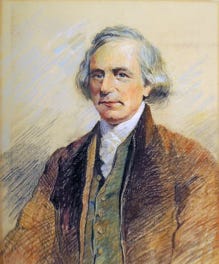
On the eve of the Revolution, the 13 colonies were vast in territory but sparse in population – about 2.5 million people, 500,000 of whom were enslaved, fewer people than now live just in Brooklyn. (That number doesn’t count Native Americans, who were already being pushed westward.) The College of New Jersey, as Princeton was then known, was similarly small – a single building, Nassau Hall, and just 13 students in Freneau’s class of 1771. But what a class it was.
“The most illustrious graduating class ever in the history of Old Nassau and, for that matter, in the history of American higher education,” the eminent Princeton history professor Sean Wilentz has written. “Indeed, the Class of 1771, more than any comparable group, created the nation, in poetry and prose as well as in politics.”
Freneau’s roommate came to Princeton from a tobacco plantation in Virginia worked by slaves: James Madison, future architect of the Constitution and president of the United States. Also in the class was Hugh Henry Brackenridge, future Pennsylvania legislator and judge, and author of a popular novel about the colonies’ western frontier; and Gunning Bedford Jr., a future signer of the Constitution, attorney general of Delaware and federal judge. And then add a couple of members of the class of ’72: William Bradford Jr., future attorney general of the United States; and Aaron Burr, future vice president and villain of the musical “Hamilton.”
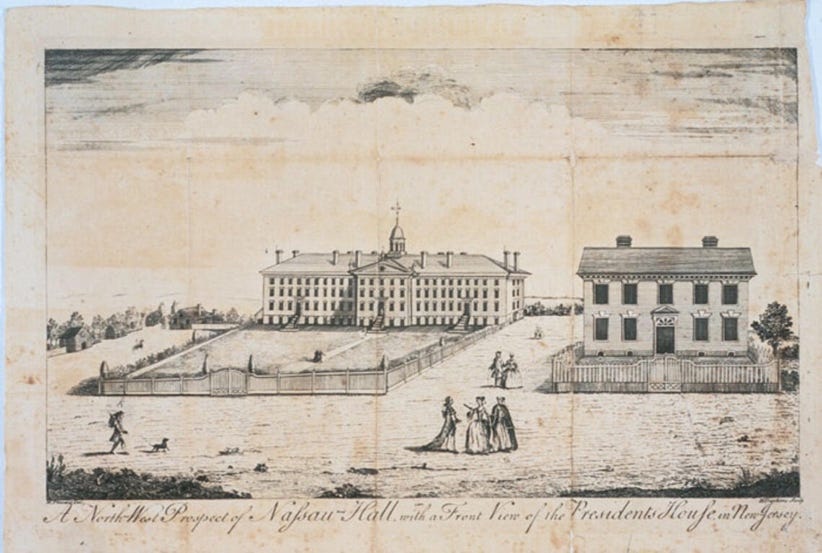
Freneau was especially close to Madison, Brackenridge and Bradford, and together they founded the American Whig Society. They didn’t advocate independence yet, but in their running debates with the Tory-leaning Cliosophic Society they were quick to criticize Great Britain when it wielded a heavy hand in the colonies. Freneau and Madison both missed the class of ‘71’s commencement ceremony in the Nassau Hall chapel, but Brackenridge was there to read a poem on which he had collaborated with Freneau, “The Rising Glory of America.”
… I see
A thousand kingdoms rais'd, cities and men
Num'rous as sand upon the ocean shore;
Th' Ohio then shall glide by many a town
Of note: and where the Mississippi stream
By forests shaded now runs weeping on
Nations shall grow and states not less in fame
Than Greece and Rome of old…”
It was mostly the work of Freneau, a soaring vision of a new nation spreading across the continent – but it was still a British nation, peopled by British subjects, protected by “Brittania’s warlike troops.”
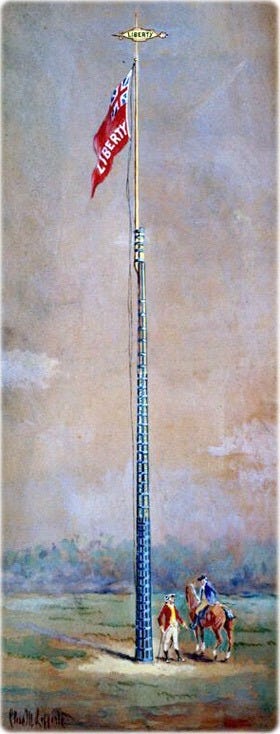
Much changed in the colonies, and in Freneau’s beliefs, over the next four years, and by April 1775, after the shooting started in Massachusetts at the Battles of Lexington and Concord, he had firmly taken a side. Much later in his life, recalling those early days of the war for a Trenton newspaper, the True American, he told the story of the first direct shots he fired, in verse – in defense of a liberty pole in New York, a symbol of protest against the British government. That April, by Freneau’s account:
“[a] gang of the disaffected to the American cause approached the unguarded Pole at midnight, hacked it down, and separated it with their axes into thirteen different portions.”
A new pole, red hickory, 75 feet tall, was quickly raised, girdled by iron spikes and guarded by two bulldogs. The poem he wrote for the dedication, “THE NEW LIBERTY POLE – Take Care!,” was “read to the surrounding multitude,” by his account, and “also printed in a hand-bill, and circulated in all directions, and carried thro’ every street, and thrown into every door in the City.”
“Seized from the woods, this honored TREE
We dedicate to LIBERTY:
Here may it stand while Time remains,
Or Liberty, with reason, reigns.”
Poems were the pop songs of that era, and Freneau, working in a tradition that carries through to Bruce now, used his to speak on the issues of the day. By July, George Washington had arrived in Massachusetts to take command of the Continental Army outside the besieged city of Boston, and the Second Continental Congress was meeting at Independence Hall in Philadelphia. On July 6, Congress adopted a resolution, the Declaration of the Causes and Necessity of Taking Up Arms. On that same day, the New-York Journal announced the publication of a new poem “humbly addressed to all true lovers of this once flourishing country, whether they shine as soldiers or statesmen,” a poem in which “Ciceronian eloquence and patriotic fare are happily blended” – “American Liberty,” by Philip Freneau. It was for sale at John Anderson’s bookstore on Beekman’s Slip, and it was soon reprinted and available in Philadelphia, too, as “The Rising Glory of America” had been several years earlier.
“What breast but kindles at the martial sound?
What heart but bleeds to feel its country’s wound?
For thee, blest freedom, to protect thy sway,
We rush undaunted to the bloody fray;
For thee, each province arms its vig’rous host,
Content to die, e’er freedom shall be lost.”
“American Liberty” sounded the same theme as “The Rising Glory of America” – a new nation, born on a new continent. But now this new nation was no longer British. It was American.
“The time shall come when strangers rule no more,
Nor cruel mandates vex from Britain’s shore;
When Commerce shall extend her short’ned wing,
And her free freights from every climate bring;
When mighty towns shall flourish free and great,
Vast their dominion, opulent their state;
When one vast cultivated region teems,
From ocean’s edge to Mississippi’s streams;
While each enjoys his vineyard’s peaceful shade,
And even the meanest has no cause to dread;
Such is the life our foes with envy see,
Such is the godlike glory to be free.”