

This post is part of the 250 section, an ongoing narrative. Visit the Your Hometown Too site on your browser to explore how the posts fit together.
In the years before the Revolution, Dr. Nathaniel Scudder’s house stood in the center of town, just as he stood at the center of the town’s life. Freehold was a village of maybe 300 people then, better known as Monmouth Courthouse, the crossroads and government seat of Monmouth County, which had a population of less than 15,000. His house was on the Burlington Path, the road laid almost a century earlier connecting the capital of East Jersey (Perth Amboy) with the capital of West Jersey (Burlington).
The house was torn down in the 1890s, and when Bruce was a teenager in the 1960s, living a block away on South Street, its spot at the corner of Main and Throckmorton was occupied by a newsstand with a phone booth outside that, because his family had no phone in their home, became his chief means of telecommunications. Rita’s Italian Ice and Frozen Custard stands there now.
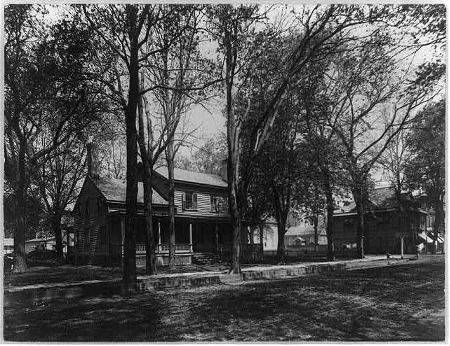
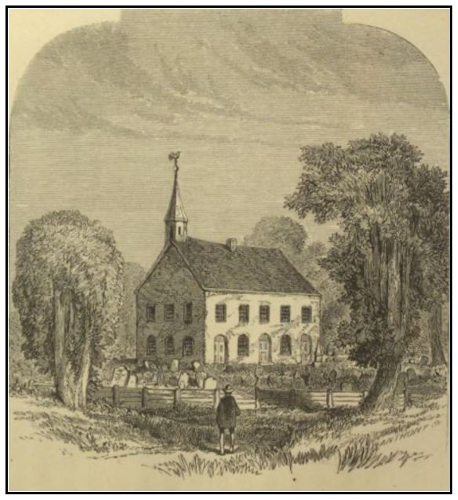
Scudder’s house was a short walk from the courthouse that gave the village its name – it stood then on the site of what is now the county Hall of Records – and just across the street from St. Peter’s Episcopal Church. That was not his church, though. Many of the Anglicans had arrived here a little later than the Dutch and the Scots, and they tended toward loyalty to the British. Scudder was a Calvinist whose church, Old Tennent, was about four miles west of his house. He leaned the other way.
He was born in Freehold in 1733 and educated at the College of New Jersey, one of 10 students in the class of 1751, just the fourth graduating class of what became Princeton University. He further trained as a physician, opened a medical practice in his hometown and involved himself in its civic affairs. He was a founder of one of the first schools in the county:
“There is lately opened a Grammar School in lower Freehold, Monmouth County, East New Jersey, by the name of Mattisonia Grammar School, where the learned languages are taught and youth qualified to enter any of the American colleges or fitted for any public business, as the arts and sciences, and especially, the several branches of mathematics will be taught with accuracy and care. The school will be under the patronage and inspection of the Reverend Messrs. William Tennent, Charles McKnight, and Dr. Nathaniel Scudder, who will be careful that it be always furnished with an able teacher, and engage frequently to visit and examine the members as to their literary improvement. All gentlemen who will favor the undertaking, may depend on having justice done their children.”
The school was located near his church in a house “finished in a genteel manner [and] situated in a very healthy place and good neighborhood, where the morals of youth will be in no danger of being corrupted.” Annual tuition and board cost 20 pounds. Among the students at the school was Philip Freneau, who later became known as “the Poet of the American Revolution.”
A week before Christmas in 1773, some Boston citizens angry at the Tea Act – passed by the British Parliament and granting the British East India Tea Company a monopoly in the American colonies – boarded a ship under cover of darkness and dumped 342 crates of tea into the harbor. Similar protests followed in other communities, including Greenwich, New Jersey. In response, an angry Parliament passed a series of harsh measures known as the Coercive Acts.
On June 1, 1774, the Boston Port Act took effect, closing the city’s port. On June 6, Scudder and six other prominent local men met to decide what to do. Scudder drafted a resolution:
Resolved That it is the unanimous opinion of this meeting, that the cause in which the inhabitants of the town of Boston are now suffering is the common cause of the whole Continent of North America; and that unless some general spirited measures, for the public safety be speedily entered into there is just reason to fear that every Province may in turn share the same fate with them; and that therefore, it is highly incumbent on them all to unite in some effectual means to obtain a repeal of the Boston Port Bill and any other that may follow it, which shall be deemed subversive of the rights and privileges of free born Americans.
They called for a halt to all trade with Great Britain and its Caribbean colonies if the acts were not repealed, and volunteered themselves to “join in an Association with the several towns in the county and in conjunction with them, with the several counties in the Province (if, as we doubt not they see fit to accede to the proposal) in any measures that may appear best adapted to the weal and safety of North America and all her loyal sons.”
The other six men – John Anderson, Hendrick Smock, Asher Holmes, Peter Forman, John Forman and Captain John Covenhoven – joined Scudder in signing the resolution. Theirs were among the first voices in New Jersey to take a public stand, according to historian Edwin Salter, “inaugurating the movements in our state which finally resulted in Independence.”